


Organic vs Natural Bedding: What the Labels Actually Mean
Organic vs natural bedding comes down to four marks. GOTS, OEKO-TEX and the two European flax marks turn up on the same shelf and cover completely different ground. Here is what each one is allowed to promise.
Anyone can print a logo. The part worth reading is the scope behind it, and the four marks you meet most often in bedding were written for four separate jobs.
GOTS is the one to hold out for when a purchase depends on certified organic natural fibre carried through a controlled processing chain. OEKO-TEX STANDARD 100 settles a narrower and more immediate worry: whether the specified article, or the certified components inside it, passed testing for harmful substances. Masters of FLAX FIBRE covers where flax was grown and how it was first processed. Masters of LINEN follows that flax on through European spinning and weaving.
Four marks, four jurisdictions
| Record | Covers | Stops at |
|---|---|---|
| 01 GOTS Global Organic Textile Standard, Version 8.0 | Textiles made from at least 70% certified organic natural fibres, with environmental, chemical, human rights and social requirements running through the post-harvest chain. The stricter grade, labelled organic, needs at least 95% certified organic fibres. | It is not a general residue test you can apply to any textile. And a certified company does not turn everything it makes or sells into a certified product. |
| 02 OEKO-TEX Standard 100 Article-level testing for harmful substances | Every thread, button and accessory inside the certified article, checked against more than 1,000 harmful substances. Bed linen sits in Product Class 2. Limit values are reviewed at least once a year, and certificates run for one year at a time. | Organic farming, fibre origin, labour conditions and closed-loop processing all sit outside it. It is also not a chemical-free mark, and no textile is chemical free. |
| 03 Masters of FLAX FIBRE The standard formerly known as European Flax | European flax origin with traceability, integrated crop management, and audited growing and scutching requirements. It is the field-and-first-mill certificate. | It says nothing about organic status, makes no promise that later manufacturing stages happened in Europe, and involves no testing on the finished product. |
| 04 Masters of LINEN European flax carried through to fabric | Certified European flax transformed through the programme's European chain: spinning, then weaving or knitting, through to finished fabric. | It does not make flax organic and it does not replace harmful-substance testing. Current rules also allow certified processing after fabric finishing outside Europe. |
Read across the row you care about. The mark worth paying for is whichever one covers the reason you are buying.
Organic vs natural bedding: scope before logo
One of these names is mid-change. European Flax is now Masters of FLAX FIBRE under the Alliance's new framework, and the older European Flax certified wording is allowed until 31 December 2026. Both are on shelves this season, and both are current.
Elsewhere the gaps are quieter. Made in a certified factory is not the same sentence as certified product. Made with GOTS-certified cotton can describe an input while the sheet in front of you carries no certification of its own. An OEKO-TEX certificate might cover a finished pillowcase, or only the fabric, or a single component inside it. The certificate says which. The logo never does.
This gets sharper with anything built in layers. Duvets and mattresses can carry a certified cover over an uncertified fill, adhesive, zip or fire barrier. Ask which article or component the number covers, then check that the product name, material and status on the certificate match the thing in your basket.
GOTS runs a public database of certified entities and their scope certificates, and it warns in plain terms that not every product made or sold by a certified operation is itself certified. A correctly labelled product shows its grade, the certifier's reference and a licence number.
Material by material
Cotton, where GOTS earns its keep
Cotton is the straightforward case. It is an agricultural fibre with a mature organic supply chain behind it, and GOTS ties approved organic fibre certification to controls on spinning, weaving, dyeing, finishing and everything downstream.
Then there is the grade to read. Organic means at least 95% certified organic fibres. Made with organic starts at 70%. Both are legitimate GOTS labels, and they are describing different cloth.
Made from organic cotton, printed on its own, is a sentence rather than a certificate. If organic farming is the reason for the purchase, ask for the GOTS label and licence number on the finished bedding instead of on a fibre somewhere upstream. A STANDARD 100 number alongside it adds article testing. It will never stand in for organic content.
Silk, where three claims get blurred together
Organic silk exists. GOTS Version 8.0 includes silk among its eligible animal fibres, and the implementation manual walks through silk processing inside the certified chain. What goes wrong is the leap from mulberry, Grade 6A or a high momme number to organic. None of those words carry that meaning.
- MulberryNames the silk source. Tells you nothing about how it was farmed.
- Grade 6AA commercial fibre-quality specification, worth asking a seller to substantiate. Not an organic certificate.
- MommeSilk fabric weight. Useful for comparing substance and intended use, silent on origin and chemistry.
- Standard 100Harmful-substance limits on the tested article or its certified components.
GOTS-certified organic silk bedding is real, though you will meet far less of it than GOTS organic cotton. So if a silk seller uses the word organic, ask to see the full GOTS labelling. Rarity proves nothing either way.
For Sensoire silk the questions are short. Is it pure mulberry silk? What momme? Does the Grade 6A claim apply to this product? Which fabric or finished article does the OEKO-TEX number cover? Four answers tell you more than a paragraph about clean luxury.
Linen, where origin and transformation are two certificates
Linen starts as flax, and natural and organic part company early. Low-input farming language and European origin are worth something. Neither of them adds up to organic certification.
The European mark to look for is Masters of FLAX FIBRE, or European Flax on stock still using the older wording. It covers origin, traceability, integrated crop management, harvesting and scutching, then stops at the first mill.
Masters of LINEN picks up from there: certified flax, European spinning, weaving or knitting, through to finished fabric. That is the one to ask for when where the cloth was made matters as much as where the plant grew.
Neither is a finished-product substance test, which is why a linen product often carries a flax mark and a STANDARD 100 number side by side. GSM belongs in the same conversation as a plain description of weight, not of growing practice or residue limits.
Bamboo lyocell, where the fibre name is the first clue
Soft bedding sold as bamboo is almost never mechanically extracted bamboo fibre. In the US, the Federal Trade Commission requires regenerated products to use an appropriate manufactured-fibre name, such as rayon or viscose made from bamboo. Lyocell belongs to the same family. Plant material is pulped, dissolved and spun into a new fibre.
Which is why organic bamboo lyocell collapses under a little pressure. Organic language can describe how a feedstock was farmed, under a separate standard. The fibre itself is manufactured, so it is not an organic natural fibre in GOTS terms. GOTS does allow lyocell as an additional fibre within defined rules, and a sheet made entirely of it does not become organic because the cellulose started life as bamboo.
Process questions get you further. Which solvent system? How much of it is recovered? Is the wood or bamboo source traceable by someone other than the seller? And is that answer about this supplier, or a figure borrowed from a different lyocell maker.
Lenzing publishes more than 99.8% solvent recovery for its own TENCEL Lyocell process. That is evidence about Lenzing fibre. It is not a default number for everything called lyocell, and a closed-loop claim should arrive with mill or manufacturer evidence attached to the fibre actually being sold. OEKO-TEX STANDARD 100 still has a job here, on harmful-substance limits for the certified article or component, and none at all on forest management or solvent recovery.
What we certify, and what we do not
Sensoire is not an organic-certified brand. Rather than stretch one badge across materials that share no supply chain, we say what each one carries.
- Silk
- The fibre, the grade and the momme where they apply, on OEKO-TEX-certified materials.
- Linen
- The fabric weight, and Masters of FLAX FIBRE™ certified fibre, formerly European Flax™.
- Bamboo lyocell
- The regenerated fibre named properly, with the applicable OEKO-TEX STANDARD 100 claim and no organic wording on the finished textile.
One quiet standard holds the range together: certified fabrics, stated weights, biodegradable materials, every claim kept inside its own scope. Biodegradable material is not a home-composting promise for a finished product, and a fabric certificate is not a certificate for a brand. We would rather name the evidence we hold than borrow the weight of a label that was never issued to us.
OEKO-TEX carries weight in this range because bedding is bought for hours of direct contact with skin, night after night. STANDARD 100 speaks to the tested article and its limit values. It does not make that article organic, and we do not dress it up as though it did.
A 60-second label check
- Read the fibre line before the badges. Bamboo on its own is incomplete for a regenerated fibre, and satin is a weave rather than a fibre at all.
- Match the badge to your reason for buying. GOTS for certified organic content and a controlled chain, STANDARD 100 for harmful-substance testing, Masters of FLAX FIBRE for European flax origin, Masters of LINEN for the flax-to-fabric chain.
- Find the number. A logo with no licence or label number attached to it cannot be checked by anyone.
- Check it at the source. OEKO-TEX numbers go into Label Check. GOTS numbers go into the certified supplier database, where you open the relevant scope certificate.
- Read what comes back. Product or component, material, product class where it applies, and whether the certificate is still valid.
- Read the fabric specification too. Momme for silk, GSM for linen. Neither is a certification, and both tell you what the cloth is actually like.
- Treat the sweeping words as decoration. Natural, green, clean, non-toxic and chemical-free name no test method and no scope.
When GOTS organic cotton is the right buy
Buy GOTS organic cotton bedding when organic crop production is not negotiable and you want that fibre kept inside a certified processing chain from field to finished sheet. The category is mature and easy to find, in sheets, duvet covers and children's bedding, and it settles something Sensoire's silk, linen and lyocell make no claim to settle.
GOTS also restricts chemical inputs and sets residue limits, so it reaches well past the farm gate. STANDARD 100 stays useful wherever the question is about the article itself, particularly across materials that were never sold as organic. Where a product carries both marks and both check out, that is the strongest position on the shelf. Verify each number separately.
Frequently asked
01Is OEKO-TEX Standard 100 an organic certification?
No. STANDARD 100 tests a certified article and its components against limit values for more than 1,000 harmful substances. Organic farming and natural fibre content sit outside it. OEKO-TEX does run a separate ORGANIC COTTON standard, which is a different certificate with a different scope.
02Is GOTS better than OEKO-TEX for bedding?
Neither outranks the other. Hold out for GOTS when certified organic natural fibre and controlled textile processing are central to the purchase. Reach for STANDARD 100 when the concern is substance testing on the specified article or component. Plenty of bedding carries both, because the scopes do not overlap.
03Does OEKO-TEX mean a product is chemical free?
No textile is literally chemical free, and the standard never claims that. A STANDARD 100 label means the certified article passed the tests and limit values set for its product class. Tested for harmful substances is the accurate phrase. Free of all chemicals is not.
04How do I verify an OEKO-TEX label?
Open the official OEKO-TEX Label Check and type in the label number exactly as printed, since it is case sensitive. Then read the result against the product, material, certified scope and validity date. If a product page shows a logo and no number, ask the seller for the number.
05Can silk be GOTS-certified organic?
Yes. GOTS permits certified organic silk within its natural animal fibre scope. Grade 6A, mulberry and momme are not part of that scope, so use the word organic only when the silk product itself carries valid GOTS labelling with a grade and licence number.
06Is European Flax the same as organic linen?
No. European Flax, now Masters of FLAX FIBRE, verifies European flax origin, traceability and defined growing and scutching practices. Organic certification is a separate standard. Masters of LINEN adds a certified European flax-to-fabric chain and still does not make the linen organic.
07Can bamboo lyocell be organic?
Lyocell is a regenerated manufactured fibre, so organic lyocell is not the same claim as a GOTS organic natural fibre label. Organic wording may apply to agricultural feedstock under a separate standard, and GOTS allows lyocell as an additional fibre in some blends. For a sheet made entirely of it, look for accurate fibre naming, process evidence, traceable feedstock and applicable harmful-substance certification.
Two companion guides
One on how the materials in this range are made and what sustainable can honestly mean, one on reading a silk specification line by line.
Four materials, four sets of evidence
Each page states the fibre, the weight and the certification that applies to that material. Nothing is stretched to cover the rest of the range.
 SILK DUVET
Grade 6A Mulberry Silk Duvet, Pure Silk Shell
Grade, shell, fill and weight are four separate facts. The product page states each one.
View product SILK PILLOWCASE
Pure Silk Pillowcase with Oxford Flange
22 momme, pure mulberry silk, Oxford flange. Weight and composition before any badge.
View product LINEN BEDDING
100% Linen Duvet Cover Set
European flax, a stated fabric weight, and a fibre name that matches the cloth.
View product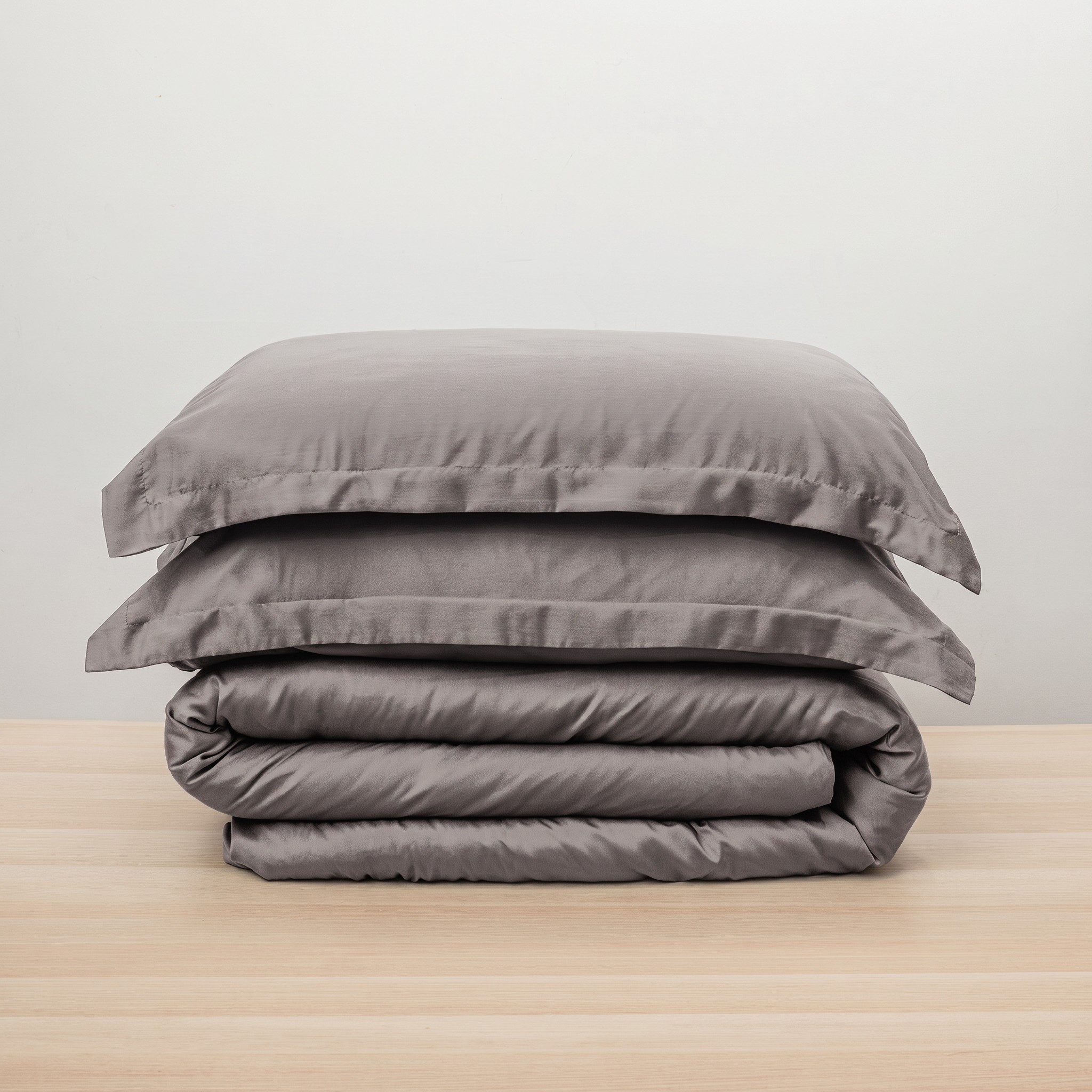 BAMBOO LYOCELL
Bamboo Lyocell Duvet Cover Set
A regenerated fibre named properly, with the substance certification that belongs to it.
View product