


Silk Materials & Weight
Mulberry silk vs tussah silk: how to choose between 16, 19, 22 and 25 momme
A clear guide to silk type, fabric weight and the details that matter when choosing pillowcases, bedding and sleepwear.
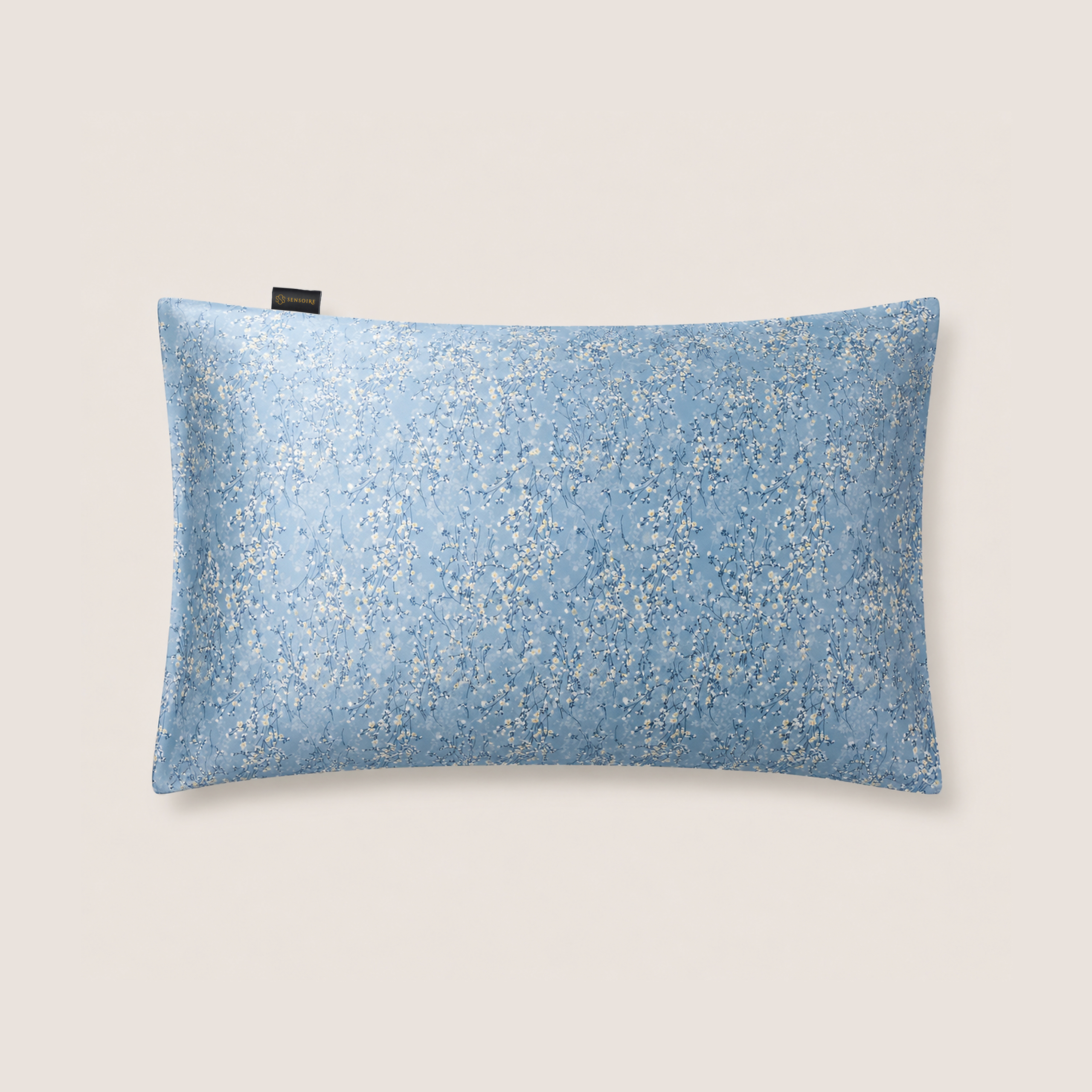
Mulberry silk vs tussah silk is the first label to decode when shopping for silk bedding, and momme is the second. A product may be described as mulberry silk, satin, 22 momme and Grade 6A, but each term refers to a different part of the fabric.
The silk type tells you where the fibre comes from. Momme describes the fabric's weight. Satin refers to the weave, while grades such as 6A usually relate to the raw silk used before the fabric is woven.
A high number on its own does not guarantee a good silk product. The most reliable way to choose is to check the fibre composition first, then consider momme weight, weave, testing and construction.
Fibre Origins
Mulberry silk vs tussah silk: what is the difference?
Both are natural silks, but they come from different silkworms and produce fabrics with a different colour, texture and hand.


Mulberry silk is produced by the domesticated silkworm Bombyx mori, which feeds primarily on mulberry leaves. Its controlled rearing conditions help create fine, relatively uniform filaments.
Tussah silk refers to a broader family of wild or semi-wild silks produced by moths of the Antheraea genus. These silkworms are typically raised outdoors or in semi-wild environments and often feed on oak leaves, giving the fibres a naturally more varied character.
For how the two fibres behave as a duvet fill, see mulberry silk vs wild silk. For the fibre itself, what is mulberry silk follows it from cocoon to fabric.
The spellings tussah, tussar and tasar are often used interchangeably in retail and textile contexts. Naming conventions vary by region, but the terms generally refer to related types of wild silk.
Both are natural silks. Tussah silk is neither synthetic nor imitation silk, but it is distinct from mulberry silk in its origin and fibre characteristics. The two materials can be identified as separate silk fibres through professional textile analysis.
| Feature | Mulberry silk | Tussah silk |
|---|---|---|
| Silkworm | Bombyx mori | Antheraea species |
| Main food source | Mulberry leaves | Oak and other host leaves |
| Natural colour | Usually ivory, cream or pale yellow | Often beige, tan, brown or naturally golden |
| Fibre character | Fine, smooth and relatively uniform | Coarser, more irregular and textured |
| Fabric feel | Soft, fluid and smooth | Crisper, firmer and more textured |
| Common uses | Pillowcases, sleepwear, bedding and eye masks | Textured clothing, furnishings and decorative textiles |
| Dyeing | A light base takes clear colours more easily | Natural pigments can make bleaching and dyeing more complex |
Tussah fibres contain natural pigments and small amounts of tannin that are more difficult to remove during processing. The fibre is also generally broader and flatter than mulberry silk, which contributes to its firmer, more textured appearance.
For pillowcases and bedding that sit directly against the skin, many people prefer the smoothness and drape of mulberry silk. Tussah can be a considered choice when a firmer hand, natural colour or visible texture is part of the design.
The distinction should not be reduced to good silk versus bad silk. The problem arises when tussah silk is sold as 100% mulberry silk without accurate labelling.
Fabric Weight
What does momme mean in silk?
Momme is the traditional unit used to measure the weight of silk fabric. It is often abbreviated to mm or m/m, although it has nothing to do with millimetres.
One momme is approximately 4.34 grams per square metre. This conversion is also documented in textile sourcing material published through the United Nations International Trade Centre.
A higher momme number means that the fabric contains more silk by weight per unit of area. It will usually feel denser, look less transparent and withstand wear better than a lighter fabric made to the same standard.
Momme does not identify the silk species, confirm purity or measure the quality of weaving, dyeing and sewing. Two 22 momme pillowcases can still feel and perform differently.
Light, fluid and slightly more translucent. Often used for scarves, light sleepwear, travel pieces and lighter pillowcases.
A practical balance between lightness and durability for everyday pillowcases, sleepwear and eye masks.
Denser, more opaque and generally more durable. Well suited to premium pillowcases, sheets and duvet covers.
Substantial, opaque and heavier in the hand. Used for dense pillowcases and heavier luxury bedding.
Weight by Use
Which momme should you choose?
The best weight depends on the product, how often it will be used and whether you prefer a lighter or more substantial hand.
Weight also shapes how the fabric feels on warm or humid nights; why silk bedding regulates temperature explains the fibre behaviour behind that.
Is 16 momme silk good?
A 16 momme fabric can be genuine 100% mulberry silk. The lower weight does not make it fake. It feels light and fluid, which works well for scarves, travel pieces and lightweight sleepwear. It can also be used for pillowcases, although it will generally tolerate less friction and repeated washing than a comparable 19 or 22 momme fabric.
Is 19 momme silk good for a pillowcase?
Nineteen momme is a sensible entry point for everyday silk. It feels light without being excessively delicate and usually costs less than 22 or 25 momme. For shoppers trying a mulberry silk pillowcase for the first time, a well-made 19 momme product can be a better purchase than a poorly documented product claiming a much higher momme.
Is 22 momme better than 19 momme?
A 22 momme fabric contains about 16% more silk by weight than a 19 momme fabric of the same size. This usually gives it greater opacity, a fuller hand and better resistance to regular wear. For a pillowcase used every night, 22 momme is often the most balanced choice. Fibre composition, weave, finishing and construction still matter.
Is 25 momme silk worth it?
Twenty-five momme silk feels denser and more substantial. It suits people who prefer a heavier fabric or place a high value on opacity and durability. The trade-off is price and weight. Someone who likes a lighter, more fluid pillowcase may prefer 19 or 22 momme. Higher momme does not automatically mean cooler, softer or better suited to every sleeper.
| Preference | Suggested momme |
|---|---|
| Light feel and accessible price | 19 momme |
| Balance of softness, density and everyday durability | 22 momme |
| Heavier, more substantial feel | 25 momme |
| Travel or occasional use | 16 to 19 momme |
For most nightly pillowcases, 22 momme is a practical middle ground. Nineteen momme feels lighter, while 25 momme feels more substantial. The SENSOIRE 100% pure mulberry silk pillowcase is woven at 22 momme for exactly this reason, while the L'Heure de Soie bedding set is offered in both 19 and 22 momme, so each piece can be weighted separately.
Momme applies to woven silk fabric. It should not be used to judge the filling inside a silk duvet. When choosing a silk-filled duvet, look instead at the silk species, fibre length, filling weight, construction and outer fabric.
If you are choosing a pillowcase specifically, our guide to the best silk pillowcase covers grade, weave and closures alongside momme.
Buying Guidance
How to choose good mulberry silk
Good silk is judged through a group of details. Start with the fibre label, then consider weight, weave, testing and construction.
Check the fibre composition first
Words such as silky, silk touch, satin and ice silk do not prove that a product contains silk. For products sold in Europe, the fibre composition should be clearly labelled. Under EU Regulation No 1007/2011, terms such as 100%, pure and all may only be used when a textile product is composed exclusively of the same fibre.
Look for wording such as 100% mulberry silk. The label 100% silk alone may still cover different natural silk species. If mulberry silk matters to you, the product should say so explicitly.
Understand the difference between silk and satin
Silk is a fibre. Satin is a weave. A satin fabric can be made from mulberry silk, polyester, viscose or another fibre. Its shine comes largely from the weave structure and finishing, not from proof that the material is silk.
A useful product description should list both the fibre and the weave, for example 100% mulberry silk charmeuse. Polyester satin may look glossy in a photograph, so shine alone is not a reliable test.
Choose momme according to the product
A higher momme is not always the right answer. Light sleepwear and travel accessories often work well at 16 to 19 momme. Pillowcases and everyday bedding commonly sit between 19 and 22 momme. Twenty-five momme suits people who prefer a denser, more substantial fabric.
Be cautious when a seller promotes a high momme number but does not disclose the silk species, fibre composition or testing.
Do not rely on Grade 6A alone
Grade 6A is commonly used to describe a high grade of raw mulberry silk. It should not be treated as a complete quality guarantee for a finished pillowcase or bedding set.
The finished product also depends on weaving, dyeing, colourfastness, finishing and sewing. Even when a product is described as Grade 6A, check whether it also provides a clear fibre composition, momme weight, fabric weave, verifiable testing, care instructions and well-finished seams.
Understand what OEKO-TEX certification proves
STANDARD 100 by OEKO-TEX tests textile products for a range of harmful substances. Its criteria cover regulated dyes, heavy metals and other chemicals of concern. The official scope is explained in the OEKO-TEX STANDARD 100 factsheet.
The certification does not, by itself, prove that a product is mulberry silk, confirm its momme weight, establish a 6A raw-silk grade or show that it is organic. A certificate number should be verifiable through the certification provider.
Look at the construction
Good silk fabric should have an even surface and a soft, controlled lustre. Large weaving irregularities, loose threads, pulled fibres or a strong chemical smell deserve closer attention.
For pillowcases, inspect the seams, piping and closure. A concealed zip should run smoothly without catching the fabric. Printed and dark-coloured products should ideally be supported by colourfastness and harmful-substance testing.
Home burn tests are not a reliable way to distinguish mulberry silk from tussah silk or silk blends. They damage the product and can only provide a rough indication that a protein fibre may be present. Professional fibre analysis is far more conclusive.
Common Questions
Silk-buying mistakes
Open each question for a direct answer.
Does higher momme always mean better quality?
No. Momme measures fabric weight. It does not replace information about fibre composition, weaving, dyeing, colourfastness or construction. A well-made 22 momme pillowcase may be a better product than a poorly finished 25 momme alternative.
Does 16 momme mean the silk is fake?
No. A 16 momme fabric can be genuine 100% mulberry silk. It is simply lighter and generally less resistant to long-term friction than a comparable 19, 22 or 25 momme fabric.
Is tussah silk fake silk?
No. Tussah is a natural silk produced by Antheraea silkworms. It is not mulberry silk and should not be labelled as such, but it can be a deliberate material choice for texture, firmness and natural colour.
Is every shiny satin fabric made from silk?
No. Polyester satin can look highly glossy. Satin describes a weave, while silk describes a fibre. Check the fibre label instead of judging the material from photographs or surface shine.
Does OEKO-TEX certification confirm the silk species?
No. STANDARD 100 tests for harmful substances. It does not identify the silkworm species, confirm that the fibre is mulberry silk or verify the fabric's momme weight.
What is the safest all-round momme for a silk pillowcase?
For most nightly pillowcases, 22 momme offers a practical balance of density, fluidity and durability. Choose 19 momme for a lighter feel and 25 momme when you prefer a heavier, more substantial fabric.
From The Atelier
Silk you can check against this guide
Each product page states the fibre, the momme weight and the certification, so the same checks used above can be applied before you buy.
 22 Momme · Grade 6A
100% Pure Mulberry Silk Pillowcase, Envelope Closure
Woven at 22 momme, the weight this guide suggests for nightly use. A hidden envelope flap holds the pillow in place, so the sleep surface stays smooth and there is no zip to catch the fabric.
- 100% mulberry silk, Grade 6A
- 22 momme
- Hidden envelope closure, no zip
- OEKO-TEX® STANDARD 100 certified
- Nine sizes, 40 x 40 to 80 x 80 cm
 19 or 22 Momme · Grade 6A
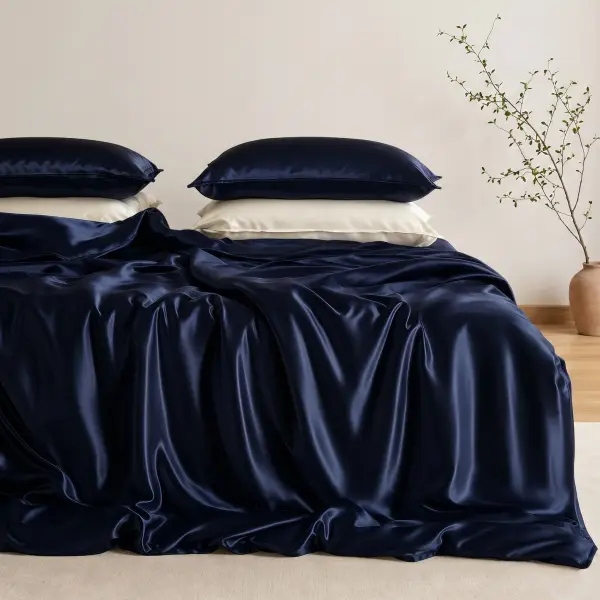
L'Heure de Soie Silk Bedding Set in Bleu Nuit
A duvet cover, sheets and pillowcases in one deep midnight blue. Offered in both 19 and 22 momme, so the lighter and the denser weight described above can be compared, and chosen, piece by piece.
- 100% mulberry silk, Grade 6A
- 19 momme or 22 momme, by piece
- Duvet cover, fitted sheet, flat sheet and pillowcases
- OEKO-TEX® STANDARD 100 certified
- Midnight blue