


The Fibre, Explained
Is Silk Breathable? Why Silk Sheets Feel Cool in Summer and Warm in Winter
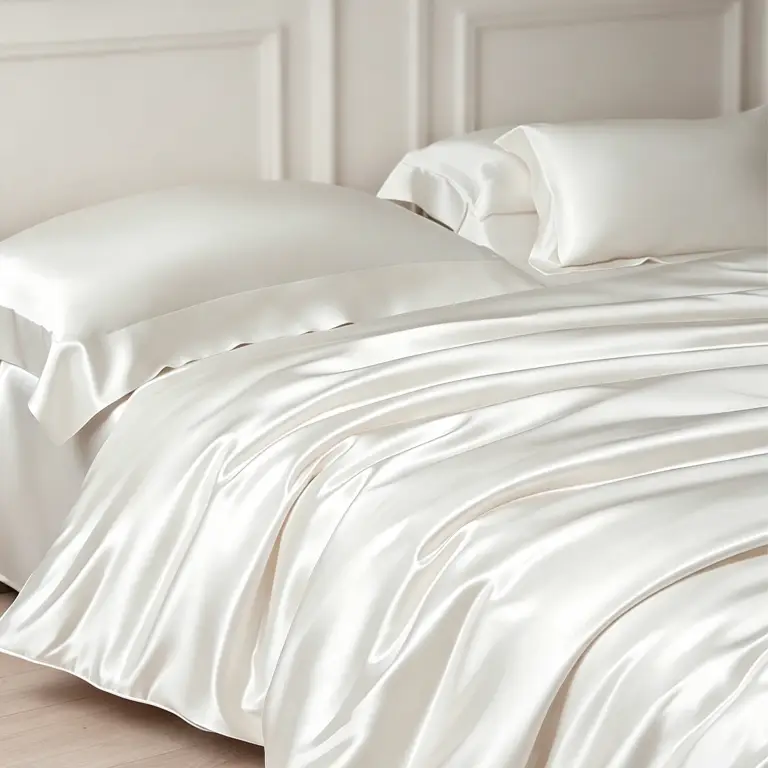
Is Silk Temperature Regulating? Quick Answer
Is silk breathable? Yes. Silk lets air and water vapour pass through the cloth and takes in moisture from the skin, so a silk sheet feels dry rather than clammy. Do silk sheets make you sweat? Not on their own. Silk absorbs more moisture than cotton and releases it again as you sleep; when a bed feels sweaty, a heavy duvet, a warm room or a synthetic layer is usually the reason.
Silk can help bedding feel comfortable in both warm and cool conditions. It absorbs some moisture and lets water vapour move away from the skin. Small spaces between the fibres also hold still air and slow heat loss. Silk does not actively cool or heat the body. Fabric weight, weave, room temperature and other bedding still matter.
Have you seen brands claim that silk bedding is warm in winter and cool in summer? It may sound contradictory. Is it simply another marketing claim? This guide starts with the unique structure of silk fibre to explain how silk regulates temperature.
How Silk Fibre Structure Supports Temperature Regulation
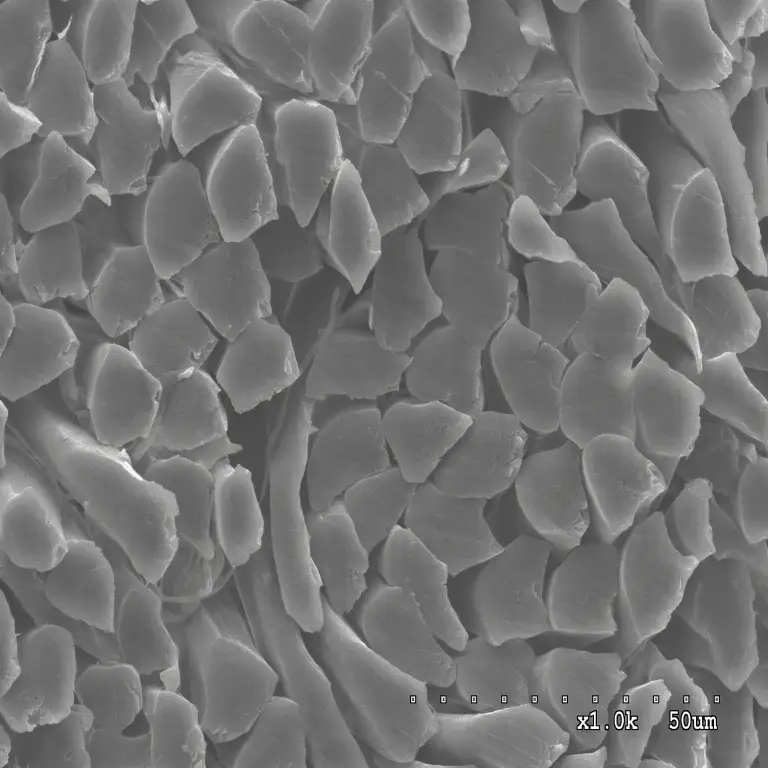
Silk is not a solid thread. Many people picture silk fibres as tiny solid tubes, like cotton or polyester. Under a microscope, silk has a triangular cross section and tiny pores at the nanoscale. This shape reflects light and gives silk a natural shine. Together with the gaps between fibres, these pores form a dense network that holds air. This structure builds one of the best insulators. These small spaces can hold warmth and give heat and moisture a way to escape.
Does Silk Bedding Keep You Cool in Summer?
Silk can help bedding feel drier on warm nights. It absorbs more moisture than cotton (a commercial moisture regain of 11.0% against 8.5%) and lets air and water vapour move through the fabric, so the layer against your skin feels less stuffy.
In summer, the body releases heat, water vapour and sweat more often. If moisture can’t move away from the skin, bedding can begin to feel hot, damp and sticky.
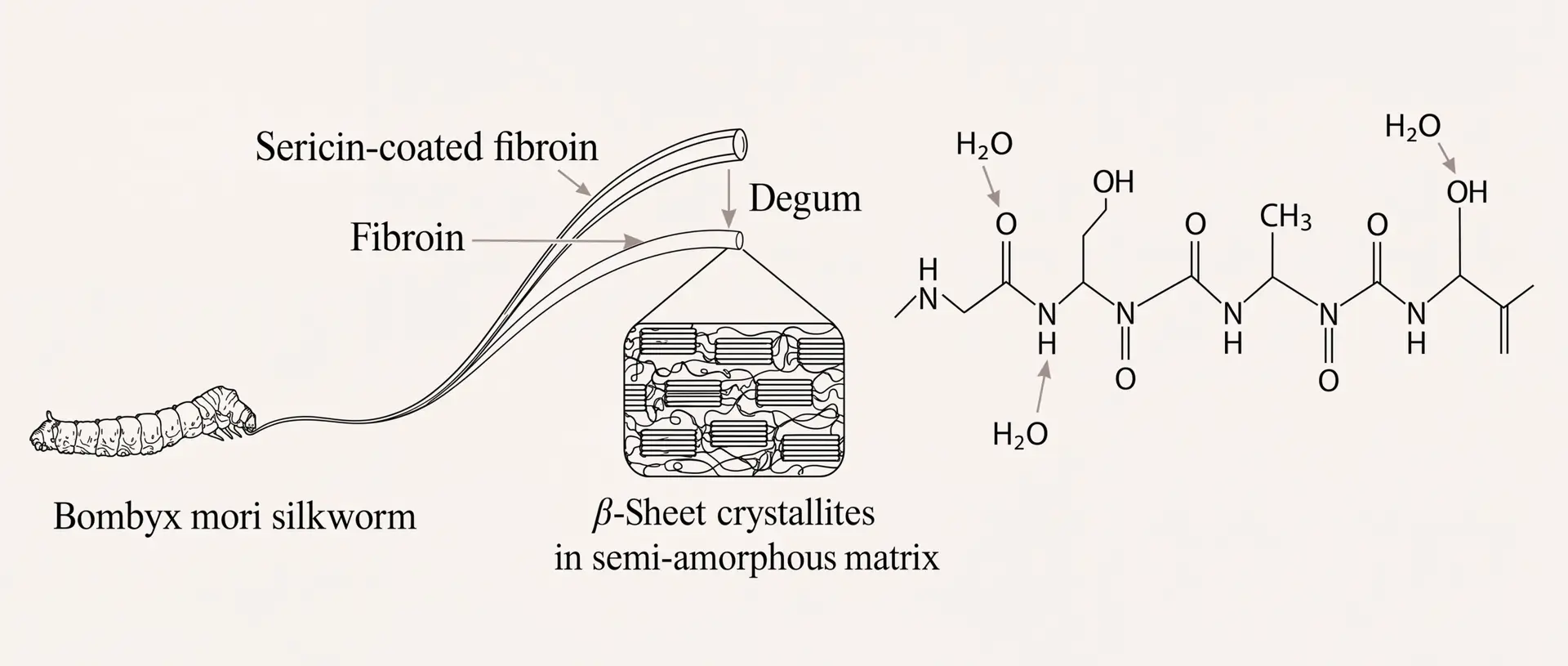
Fibroin makes up roughly three quarters of mulberry silk. The fibroin protein contains water loving groups that can bind with water molecules. This gives silk good moisture absorption. It can absorb sweat from the skin and help create a dry, comfortable sleep environment in hot summer.
ASTM International, D1909 Standard Tables of Commercial Moisture Regains for Textile Fibers: silk 11.0%, cotton 8.5%.
Small spaces between silk fibres allow air and water vapour to move through the material after absorbing. Moisture is released as the surrounding air becomes drier. The result is a lighter and less stuffy feeling through the night. At comparable low surface densities, silk recorded air permeability of 496.10 mm/s, compared with 170.59 mm/s for cotton. Its moisture vapour transmission is 337.86 g/(m²·h), compared with 294.88 g/(m²·h) for cotton. More proved data about its structure and properties click here.
Does Silk Bedding Keep You Warm in Winter?
The same porous structure that helps moisture move in summer also helps retain warmth in winter. When the temperature drops, the moisture content of silk fibroin chains decrease and contract. The tiny pores close, helping to lock in heat. In winter, silk keeps the heat released by your body close to you instead of letting it escape easily.
| Fibre | Average thermal conductivity W/(m·K) |
|---|---|
| Silk fibre | 0.042 |
| Cotton fibre | 0.058 |
| Wool fibre | 0.054 |
2023 Thermal Performance Test Report on Natural Fibres, China Textile Academy.
The average thermal conductivity of silk fibre is 0.042 W/(m·K), significantly lower than cotton fibre at 0.058 W/(m·K) and wool at 0.054 W/(m·K). It is close to the insulation level of down filling. The lower the thermal conductivity, the more slowly heat passes through the fabric. Silk keeps you warm without relying on heavy weight.
Why Mulberry Silk Feels Gentle Against the Skin

Unwind a filament and you find two components: fibroin on the inside, sericin wrapped around it. Fibroin accounts for roughly three quarters of the fibre, sericin the remaining quarter. Between them they are built from 18 amino acids, and together they make up almost all of the fibre.
Silva et al., Sericin Protein: Structure, Properties, and Applications, Journal of Functional Biomaterials (PMC): fibroin 70 to 75% and sericin 25 to 30% of silk proteins.
Silk Sericin Protein Materials: Characteristics and Applications (PMC): the 18 amino acids of silk protein.
They are similar to the proteins found in human skin and collagen. That shared chemistry is why it sits well against skin: close to skin in composition, gentle against it, holding moisture at the surface rather than stripping it. People with reactive skin tend to notice this first.
Is Silk Cooler Than Cotton and Other Fibres?
| Fibre | Data | Feel | Best For |
|---|---|---|---|
| Silk | b 74.2 Higher vapour movement than cotton | Cool touch Light warmth | Year-round sleep Temperature swings |
| Linen | b 80.3 Highest airflow | Coolest touch Very airy | Hot rooms Summer |
| Wool | b 58.7 R 34.1 × 10⁻³ | Warm touch Strong insulation | Cold rooms Winter |
| Cotton | R 0.0370 Vapour: 1,824 g/m²/day | More insulation Slower vapour movement | Mild to cool rooms |
| Polyester | Qmax 0.1638 Heat retention: 6.92% | Similar summer coolness Less retained warmth than silk | Summer layers |
The comparison does not produce one universal winner. Linen led on airflow and numerical cool touch, while wool provided the strongest insulation. Silk occupied the middle ground that matters for bedding: a cool initial touch, lighter insulation and effective water vapour movement.
Das et al. (2021), DOI 10.1007/s40034-021-00208-2
Subburaayasaran et al. (2022), DOI 10.1080/15440478.2022.2025982
Sung and Kwon (1990), DOI 10.20616/clothingresearch.33.2_48
Is Silk Bedding Good for Hot and Cold Sleepers?
Silk bedding can suit both hot and cold sleepers, because it works on the thin layer of air between your skin and the fabric: it absorbs moisture when you run warm and holds still air as you cool down. It does not replace the right duvet weight for a cold room.
People who sleep badly because of temperature do not all have the same problem. Some are hot sleepers who wake up overheated. Some are cold sleepers who never get their feet warm. Plenty get both in the same night.
But the problems converge on one place: the thin layer of air between your skin and the fabric touching it. That layer is exactly what silk works on. In a bed, that fabric is the sheets, the duvet cover and the pillowcase against your skin, the silk bedding set itself.
If you are still deciding whether to buy, the article Are silk sheets worth it? covers labels, momme and price.
| If you… | The problem | How silk helps | Start with |
|---|---|---|---|
| Wake up sweaty | Damp skin Clingy bedding Stuffy heat | Absorbs moisture Helps water vapour move away Feels less clammy | Silk pillowcase Lightweight bedding layer |
| Get hot flushes at night | Sudden heat Sudden chill Constant cover changes | Handles moisture during warmth Holds light air as you cool | 19 or 22 momme bedding |
| Sleep cold | Cold feet Fast heat loss Too many layers | Holds still air Slows heat loss Avoids a heavy feel | 22 momme bedding Suitable duvet layer |
| Sleep hot and cold | Overheating, then chilling Unstable comfort | Balances moisture and light insulation | Full silk contact layer |
| Toss and turn | Drag on skin Friction on hair | Smooth, low-friction surface | Silk pillowcase |
| Have sensitive skin | Repeated overnight contact Need for a gentler surface | Smooth, soft contact layer | Silk pillowcase Silk sheet |
Here are some things you should know. Silk can’t stop sweating, treat hot flushes or night sweats, cool a hot mattress, or replace the right duvet weight for a cold room. It works best as the layer closest to your skin, alongside bedding and room conditions that suit your sleep.
Not sure which weight?
Find Your Silk Duvet
Six quick questions about the season, your bedroom and how you sleep. We will suggest the weight, the size and the Sensoire duvet to match.
Reference
Silk Temperature Regulation Research
Silk Bedding Temperature Regulation: Fibre Facts and Figures
Composition
- Fibroin
- around 3/4 of the fibre
- Sericin
- around 1/4 of the fibre
- Amino acids
- 18
- Protein content
- almost all of the fibre
Structure & Surface
- Cross-section
- approximately triangular
- Surface
- smooth at a microscopic scale
- Coefficient of friction
- among the lowest of any textile fibre
Moisture
- Moisture regain, standard conditions
- about 11% (ASTM D1909)
- Cotton, for comparison
- about 8.5% (ASTM D1909)
- Fibroin core
- absorbs more than the whole fibre
Absorption figures differ depending on whether the whole fibre or the fibroin core is measured. Both are given above.
Questions
FAQs About Silk Temperature Regulation
Does Silk Regulate Body Temperature?
Silk does not control body temperature directly. It helps manage moisture and air around the skin. This can make bedding feel more comfortable when conditions change.
Does Silk Keep You Cool in Summer?
Silk absorbs some moisture and allows water vapour to move through the fabric. This can reduce a hot, damp and sticky feeling. It does not lower the temperature on its own.
Does Silk Keep You Warm in Winter?
Small spaces between silk fibres can hold still air and slow heat loss. The warmth also depends on the fabric weight, duvet filling, room temperature and other bedding layers.
Are Silk Sheets Good for Hot Sleepers?
Silk sheets may suit hot sleepers who prefer smooth bedding with good moisture movement. Choose a fabric weight and weave that suit the room and season.
Is Silk Cooler Than Cotton?
The result depends on the fabric weight, weave and test conditions. The research cited in this article found higher airflow and moisture vapour movement in certain silk samples than in comparable cotton samples.
Do silk sheets make you sweat?
Not on their own. Silk absorbs more moisture than cotton and lets water vapour pass through, so the layer against your skin stays drier. If you wake up sweaty under silk sheets, look first at the duvet weight, the room temperature and any polyester layer in the bed.
Are silk sheets hot in summer?
No. A 19 or 22 momme silk sheet is light, breathable and moves moisture away from the skin, so it suits warm nights. Pair it with a light summer duvet, or sleep under the sheet alone; the duvet, not the sheet, decides how hot the bed feels.
Where to Begin
Sensoire silk, woven for the layer that touches you
Everything above, the whole story of why silk bedding regulates temperature, happens in the contact layer. That is the part worth changing first.
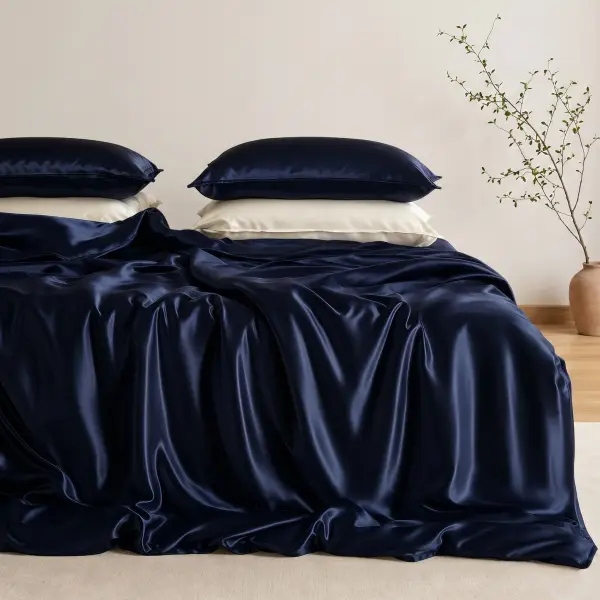 19 or 22 Momme · Grade 6A
L'Heure de Soie Silk Bedding Set in Bleu Nuit
The full contact layer, in one deep midnight blue: duvet cover, fitted sheet and flat sheet, each sold on its own. Offered in 19 and 22 momme, so the lighter and the denser weight can be chosen piece by piece.
- 100% mulberry silk, Grade 6A
- 19 momme or 22 momme, by piece
- Duvet cover, fitted sheet and flat sheet, sold separately
- OEKO-TEX® STANDARD 100 certified
- Midnight blue
 22 Momme · Grade 6A
100% Pure Mulberry Silk Pillowcase, Envelope Closure
The single square you spend the most hours pressed against, and the smallest place to start. A hidden envelope flap holds the pillow in place, so the sleep surface stays smooth and there is no zip to catch the fabric.
- 100% mulberry silk, Grade 6A
- 22 momme
- Hidden envelope closure, no zip
- OEKO-TEX® STANDARD 100 certified
- Nine sizes, 40 x 40 to 80 x 80 cm
 Silk-Filled · Grade 6A
Box-Quilted Mulberry Silk Filled Duvet
The cold-sleeper answer above, in duvet form: long-strand silk fill that holds warm air without weight, box-quilted so it stays evenly lofted, in a cotton sateen shell. Four fill weights let you match the season instead of the duvet.
- Long-strand Grade 6A mulberry silk fill
- 100% cotton sateen shell, box-quilted
- Summer 180, mid-season 320, winter 500 g/m², or four-season pair
- OEKO-TEX® STANDARD 100 certified
- 140 × 200 cm to 260 × 240 cm
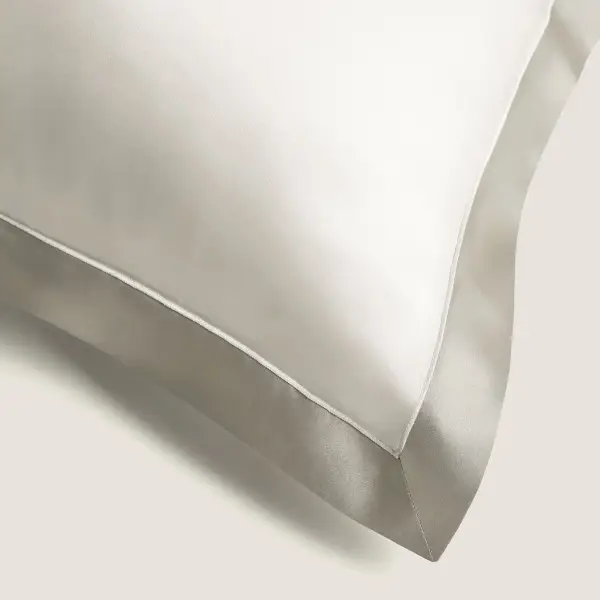 22 Momme · Grade 6A
Pure Silk Pillowcase with Oxford Flange
The smooth, low-friction surface this article describes, answered at the pillow: 22 momme charmeuse with a tailored Oxford flange and a hidden envelope closure, so there is no zip against your face when you turn.
- 100% mulberry silk, Grade 6A
- 22 momme charmeuse
- Tailored Oxford flange, hidden envelope closure
- OEKO-TEX® STANDARD 100 certified
- Nine sizes, 40 x 40 to 80 x 80 cm