


Fibre Guide · Silk Duvets
What Is Double Cocoon Silk, and Why Does It Cost More?
Two silkworms, one cocoon. It happens in every harvest, and for most of the silk industry it is a nuisance: the filaments cross, the thread will not unwind, and the cocoon is set aside as defective. Double cocoon silk is that set-aside pile. It is also what the better silk duvets are filled with, and a large part of why they cost what they do. Here is what changes when two worms share a cocoon, and how to tell whether you are actually buying it.
01Definition
What is double cocoon silk?
Double cocoon silk comes from a cocoon spun by two silkworms rather than one. The two larvae settle into the same space when they are moved onto the frames where they spin, and they work at the same time, so their filaments wind around and through each other instead of laying down in one continuous coil. The cocoon that results is larger than an ordinary one, heavier, and slightly irregular in outline. Open it and there are two pupae inside.
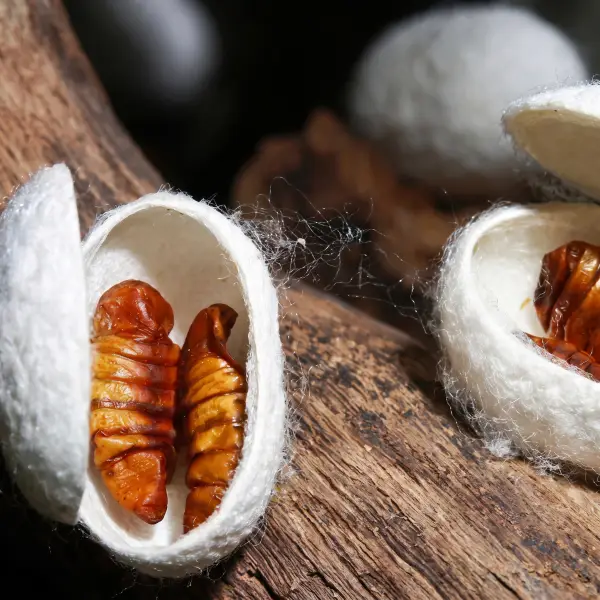
The material travels under several names. In the fabric trade it is doupion, dupion or dupioni, after the yarn it is spun into. On a duvet label it is usually written double-cocoon, often paired with long-strand, which describes how the fibre is prepared rather than where it came from. They all point back to the same event in the rearing shed. For the species question underneath all of this, what mulberry silk is and how it differs from tussah are the place to start.
It is worth saying plainly that the event is accidental. The FAO silk reeling manual lists crowded conditions on the spinning frames, high temperature and high humidity among the reasons two larvae end up sharing a cocoon. Nobody sets out to make them. They appear, they are sorted out by hand, and then they have to find a use. Everything else below follows from that.
02The reject pile
Why weaving mills will not take it
Ordinary silk fabric begins with reeling. The cocoon is softened in hot water, the loose end of its filament is found, and that single strand, which on a good cocoon runs well over a kilometre, is unwound and twisted together with a few others into one smooth thread. The whole process rests on two conditions: the filament has to be continuous, and it has to come off the cocoon in one direction.
A double cocoon fails both. Two filaments are wound through one another, so the strand catches, snags and breaks. The FAO manual puts it flatly: a double cocoon “does not unwind smoothly and tangles easily”, and since it cannot be reeled alongside normal cocoons it is diverted into doupion, a coarse and uneven yarn.
That yarn becomes doupioni fabric, the crisp textile with slubs running visibly across it, used for structured work: jackets, curtains, upholstery. It is a good cloth. It is not a smooth one, and it is not what anyone wants against their face at night. So for a mill sorting cocoons for sheeting or lining, the double cocoon is simply a reject, and it is priced like one.
The same cocoon, two verdicts
At the reeling mill
Filaments cross, so the thread breaks. Classified as a defect, sorted out by hand, sold on for coarse yarn.
At the duvet workshop
Filaments cross, so the sheet holds together. Selected on purpose, opened by hand, laid into the core.
03The reversal
Why duvet makers want exactly what the mill rejects
A duvet is never reeled. Silk fill is made the other way round: the cocoon is softened, opened out, drawn by hand into a wide and almost transparent sheet, and those sheets are laid across one another in alternating directions until the core is even. Nothing is unwound. Nothing has to be continuous in one direction.
Under that process, the property that ruins reeling becomes the whole point. Filaments that already cross one another open into a connected web rather than a bundle of parallel threads, and a web holds its own shape. It traps air between the layers, and it resists being pushed into one corner of the shell.
Three things follow once it is on the bed. The fill carries more air for its weight, so it warms without pressing down. It springs back after compression instead of staying flat where a body has lain. And it resists matting, which is how most duvets actually die: fibres knitting into dense patches with cold gaps opening between them. How a silk duvet is made follows the full sequence, and why silk bedding regulates temperature covers what the same structure does with the moisture you give off overnight.
04 The ladder
Where double cocoon silk sits among duvet fills
Silk fill is not one material. Four different things are sold under the same word, and over a decade on a bed they behave nothing alike.
Four things sold as silk fill
01
Long-strand double cocoon silk
Opened, never cut. The naturally crossed filaments are drawn into wide sheets and cross-layered by hand. Holds its loft longest and resists matting best. This is the fill in every Sensoire silk duvet.
02
Long-strand single cocoon silk
The same careful preparation, from ordinary cocoons. The filaments run parallel, so the sheets are smooth but hold their structure less firmly once they have been compressed for a few years.
03
Short-fibre silk fill
Silk cut or broken into short lengths, then packed or blown into the shell. Soft on the first night, quick to make, and inclined to migrate and mat within a few seasons.
04
Silk-blend and silk-topped fill
A layer of silk over a synthetic or feather core, usually with silk foremost on the label. Read the fill percentages before anything else on the page.
Price follows that order, and so does lifespan. A duvet filled with long-strand double cocoon silk, kept under a cover and aired rather than washed, lasts around 15 to 20 years. Short-fibre fill flattens in a small fraction of that, which is the real reason the cheaper duvet is rarely the cheaper decision.
05Scarcity and price
How rare is double cocoon silk, and does that justify the price?
Double cocoons are a small share of any harvest and they have to be picked out by hand before reeling starts. Figures of three to five per cent circulate widely in the fabric trade. Treat them as an order of magnitude rather than a specification: they are trade estimates, and the FAO manual, which is the closest thing to a neutral reference, classifies double cocoons as a defect category without putting any percentage on them.
Scarcity is only part of the price in any case. The larger part is labour. Opening the cocoons, drawing every sheet by hand and cross-layering them into an even core is slow work, and it is still done by hand because the alternatives do not produce the same core. Add the shell, the sheer quantity of fill a full-size duvet needs, and certification to OEKO‑TEX Standard 100, and the premium stops looking like a surcharge on the word silk.
Is a silk duvet worth it works through that arithmetic against down, wool and synthetic. If you have already decided on silk and are choosing between warmths, the duvet weight guide is the next step.
06 Buying
How to check you are buying double cocoon silk
None of the four checks below needs a laboratory, and the middle two can be done with the duvet in front of you in about a minute.
Four ways to check what you are buying
01
Read the fill line, not the headline
100% mulberry silk names the species and nothing else. It does not tell you the strand length, and it does not tell you whether the cocoons were double. The phrase worth looking for carries both halves: double-cocoon and long-strand. When a page gives only the species, the rest is usually missing for a reason.
02
Ask to see the fill
A duvet with nothing to hide will show you what is inside. Ours carry a zipped inspection opening of about 15 cm in the shell for exactly that purpose, on every size and every weight. Long-strand floss reads as a connected sheet. Short fibre reads as loose wadding.
03
Pull it, do not stroke it
Take a small amount between your fingers through the opening and draw it outwards. Long-strand silk comes away as a web that keeps stretching with it. Short fibre separates into fluff almost at once. A soft hand feel can be bought cheaply; this cannot. If you are further back than that and still checking the fibre itself, how to tell if silk is real sets out five tests.
04
Read the quilting
Long-strand fill is held by widely spaced box quilting or by hand tacking, because it does not need much holding. Dense machine quilting across the whole surface is a sign that the fill would otherwise move, and it presses out the loft you are paying for.
The pure silk shell duvet is the one to open first if you want to see what the second and third checks are describing, because the shell is silk on both sides and the fill reads clearly through the opening.
Questions we hear most
What is double cocoon silk?
Double cocoon silk comes from a cocoon spun by two silkworms together rather than one. Their filaments wind through each other instead of forming a single continuous strand, which makes the cocoon larger and impossible to reel into smooth thread. Opened into floss instead, that crossed structure is what gives silk duvet fill its loft and its spring.
Is double cocoon silk the same as dupion or doupioni silk?
It is the same raw material under a different name. Doupion, dupion and dupioni all refer to the yarn and the fabric spun from double cocoons, which is why the cloth has its characteristic slubs. Bedding uses the word differently: on a duvet label, double-cocoon describes the fill inside, not a woven fabric.
Is double cocoon silk better than single cocoon silk?
For duvet fill, it holds up better over time. The crossed filaments open into a connected web that traps more air and resists matting, so the duvet keeps its loft for longer under the same use. For woven fabric the judgement reverses completely, because those same crossed filaments cannot be reeled into a smooth thread.
Why is double cocoon silk more expensive?
Two reasons, and the smaller one is scarcity. Double cocoons are only a small share of a harvest and have to be sorted by hand. The larger cost is the preparation: the fill has to be opened, drawn into sheets and cross-layered by hand, which is slow and cannot be shortened without changing the result.
Can double cocoon silk be woven?
Only into doupioni, the crisp textured fabric used for jackets, curtains and upholstery. It cannot be reeled into the fine even thread that smooth silk fabric needs, which is why weaving mills classify double cocoons as a defect and sort them out before reeling.
How long does a double cocoon silk duvet last?
Around 15 to 20 years when it is kept under a duvet cover and aired rather than washed. Long-strand double cocoon fill holds its loft far longer than short-fibre fill, which flattens within a few seasons. Keeping it under a cover is the single thing that matters most.
Two silkworms share a cocoon. A reeling machine reads that as a fault and sets it aside; a duvet workshop reads the same cocoon as the one it wants and sorts it into the opposite pile. The material never changed. Only the question being asked of it did. When you are comparing silk duvets, the fill line is where that question gets answered, and it deserves more of your attention than anything printed about the shell. The four in the silk duvet collection share one fill and differ only in the shell and the quilting, and how to clean a silk duvet covers keeping it that way.
Reeling facts and the defect classification are drawn from the FAO Silk Reeling and Testing Manual. The three to five per cent figure is a trade estimate and is presented as one.
From the Collection


Cotton Shell · White Piping
Grade 6A Mulberry Silk Duvet with 100% Cotton Sateen Shell and White piping

Cotton Shell · Black Piping
Grade 6A Silk Filled Duvet with 100% Cotton Sateen Shell and Black piping
