


Fibre, tested
How to Tell If Silk Is Real: 5 Tests From Label to Burn Test
How to tell if silk is real starts with what cannot prove it: shine, price or the word satin. The composition label is the only claim you can hold a seller to; the five tests below show what a swatch does under light, tension, moisture, flame and chlorine, and which of them you should never repeat at home.
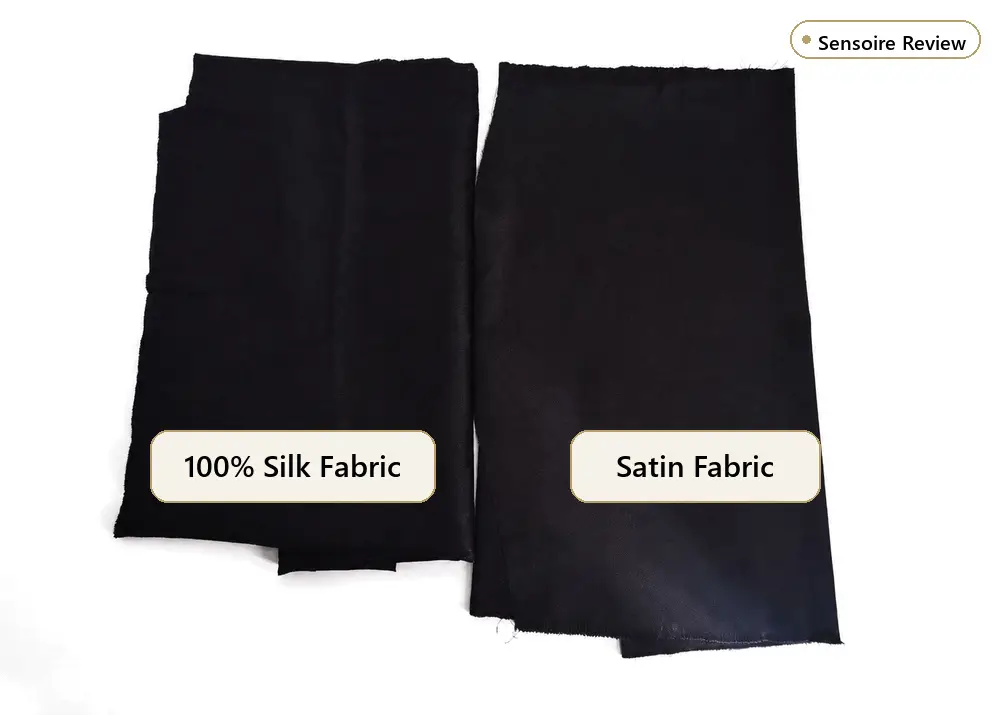
The short answer: read the label first. Genuine silk is declared as a fibre percentage, 100% silk or 100% mulberry silk, on the permanent label. Everything below is what happened when Sensoire put a swatch labelled 100% silk beside a swatch labelled satin and ran the same five checks on both. The photographs are real; the conclusions are deliberately narrow.
If you are still working out what the two words mean, start with silk vs satin: what is the difference. If you are choosing a pillowcase, silk vs satin pillowcase: which is better for hair and skin compares the finished products.
A test tells you about the swatch on the table. The label tells you what you are buying.

How to tell if silk is real: the five tests at a glance
How to tell if silk is real: read the composition label first, then use the five tests below as supporting evidence. Light and stretch give clues, the one-hour wrist test shows how the fabric handles skin moisture, the burn test only proves anything in a lab, and the chlorine bleach test is decisive but destroys the sample.
| Test | What we saw | What it proves | Safe at home? |
|---|---|---|---|
| 1. Light | Silk let more light through; both looked glossy | A clue, not a verdict | Yes |
| 2. Stretch and crease | Silk 27 to 32 cm, satin 27 to 36 cm; silk creased more | Different behaviour, not identity | Yes |
| 3. Wrist moisture | 34% on the silk side, 19% on the satin side after one hour | One person, one meter: an observation | Yes |
| 4. Burn | Silk curled to a crushable residue; satin flamed and hardened | Indicative, and only in a controlled setting | No |
| 5. Chlorine bleach | Silk broke down in 30 minutes; satin did not | Decisive for protein fibre, and destructive | No |
Test 01 · Light
Test 1: Can shine tell you whether a fabric is silk?
Not with certainty. Under the same light our two black swatches reflected light differently, yet both looked smooth and lustrous. Someone who handles fabric every day may form a useful first impression, but a glossy face is not proof of silk. Fibre is only one part of what the eye sees. Yarn shape, weave, density, colour, finishing and wear all change the reflection. A manufactured filament can be highly glossy. Real silk can look quiet after a matte finish or in a different weave.
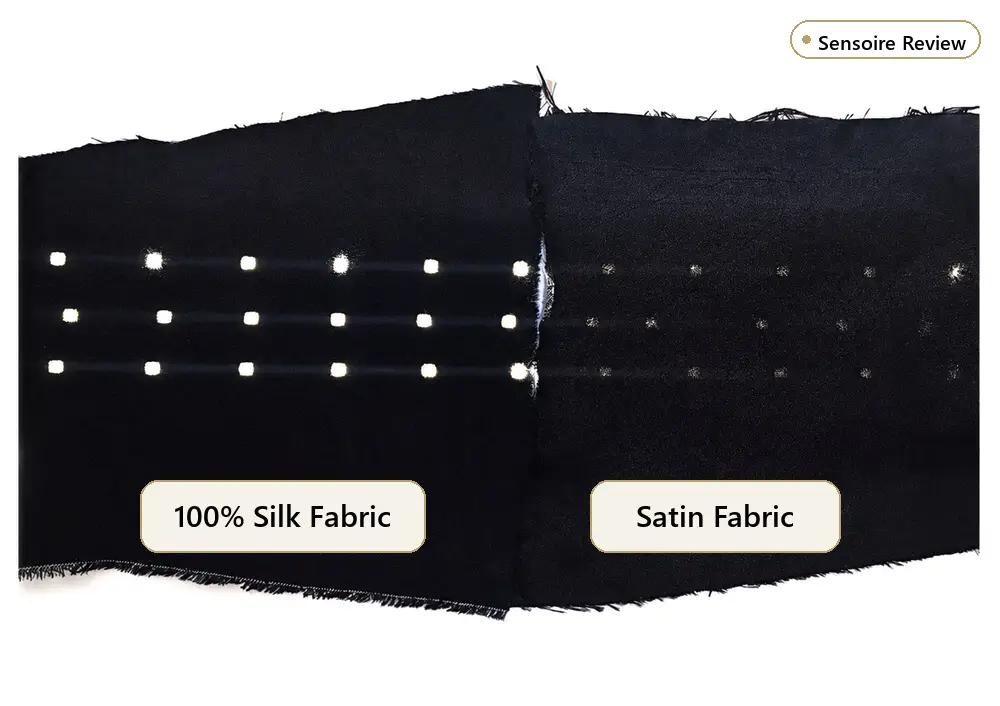
Backlighting adds another clue, and it also needs context. We placed the two samples over the same light source. More points of light came through the silk sample than through the satin sample.
The photograph records a clear difference between these two fabrics. It does not mean all silk is more transparent than all satin. A denser, heavier silk may pass very little light, while a lightweight satin in another fibre may pass more.
Momme helps describe silk fabric weight, as the momme guide explains. One momme is about 4.34 grams per square metre, but the number is not a purity test, and the highest number is not automatically right for every product. A lighter silk may suit a fluid scarf, while bedding usually calls for a different balance of weight, hand and durability.
Test 02 · Tension & Crease
Test 2: Do stretch and creasing tell silk from satin?
Partly. Stretch and creasing show how a fabric behaves under tension and after folding. In our comparison two swatches of about 27 centimetres were pulled against the same ruler and then creased. The differences are visible, but a well made polyester satin can imitate them, so treat this as a clue that supports the label rather than as proof.
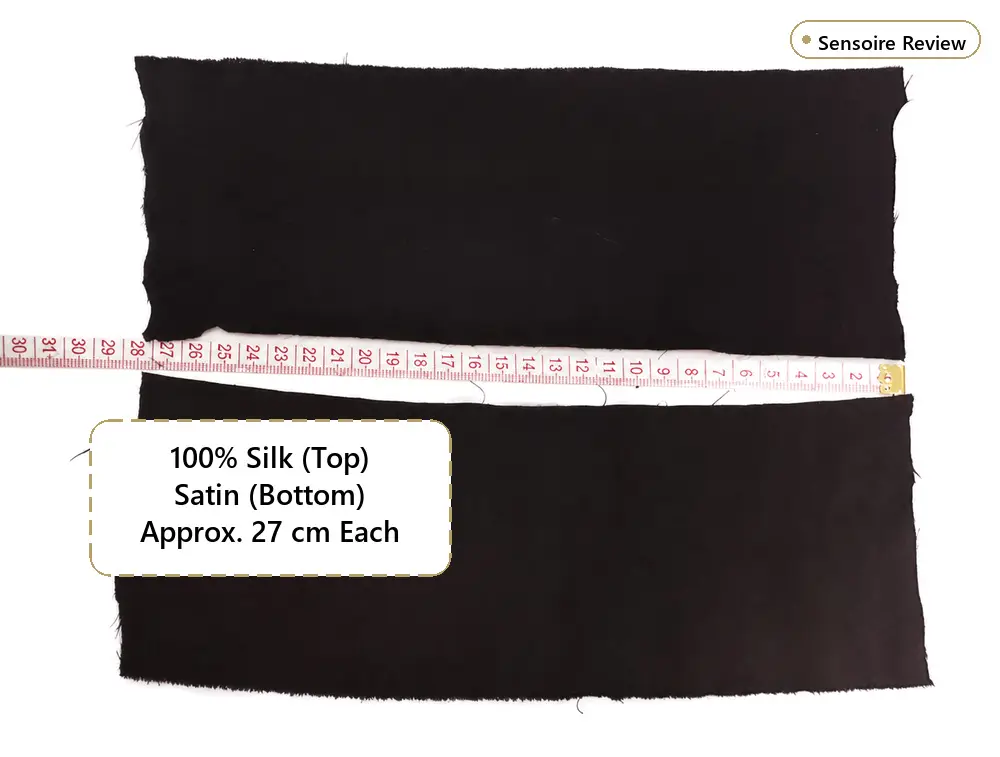
Our stretch comparison began with two pieces measuring about 27 centimetres, laid against the same ruler.
The question was not which fabric wins. It was simpler: when two surfaces share the same dark sheen, do they also share the same behaviour? Each sample was then pulled by hand from that same starting length.
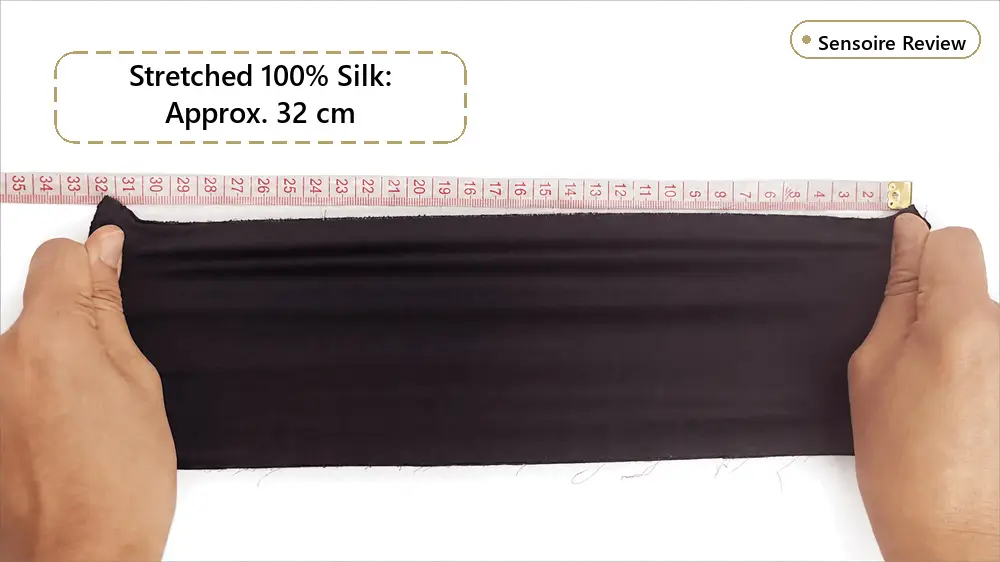
Pulled by hand, the silk sample reached about 32 centimetres, roughly five centimetres beyond its resting length.
Silk has natural give, but in this pairing it was the more reserved of the two.
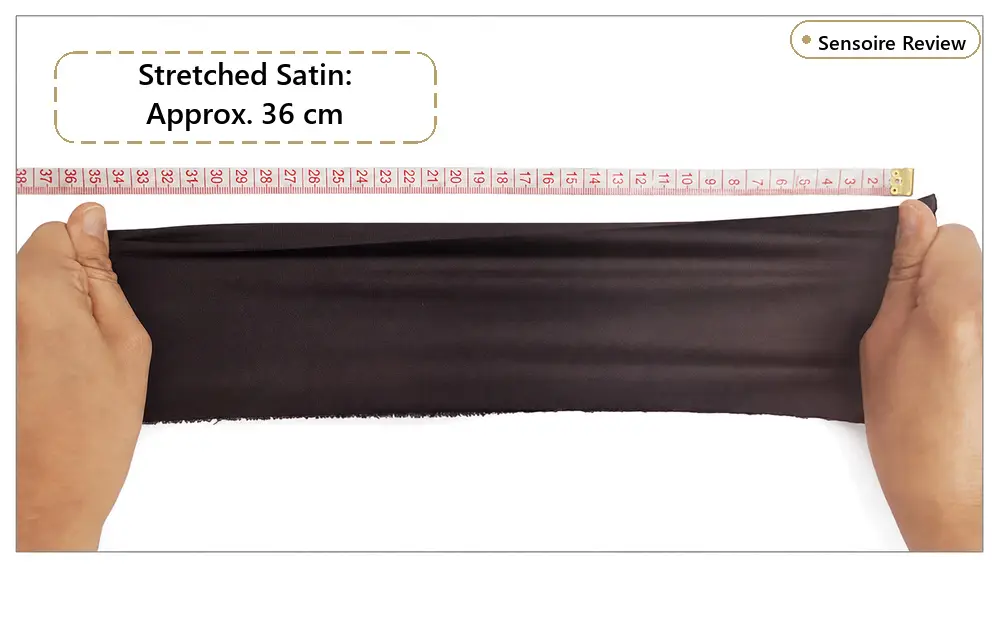
The satin sample reached about 36 centimetres in the same test. It travelled farther, and that still does not turn stretch into an authentication method.
Elastic response depends on the fibre, the yarn, the weave or knit, the finish, the direction of the sample and whether an elastic fibre is present. The modest, useful point is that two fabrics with a similar sheen can behave very differently under tension.
Creasing produced another visible contrast. We folded both samples and kept them under the same weight for one hour. Unfolded, the silk showed stronger pressure marks and the satin looked less marked.
Finishes and blends change crease recovery, so this result belongs with the samples in the photograph. It helps when comparing their hand and drape, not as a verdict on every silk or satin textile.
Test 03 · Moisture
Test 3: The one-hour wrist test
The wrist test measures what a fabric does to skin moisture over an hour of contact. We started from a skin moisture reading of 16% and wore each swatch against the wrist for an hour before measuring again. The point is not the exact figure but whether the fabric lets the skin keep its moisture or draws it away.
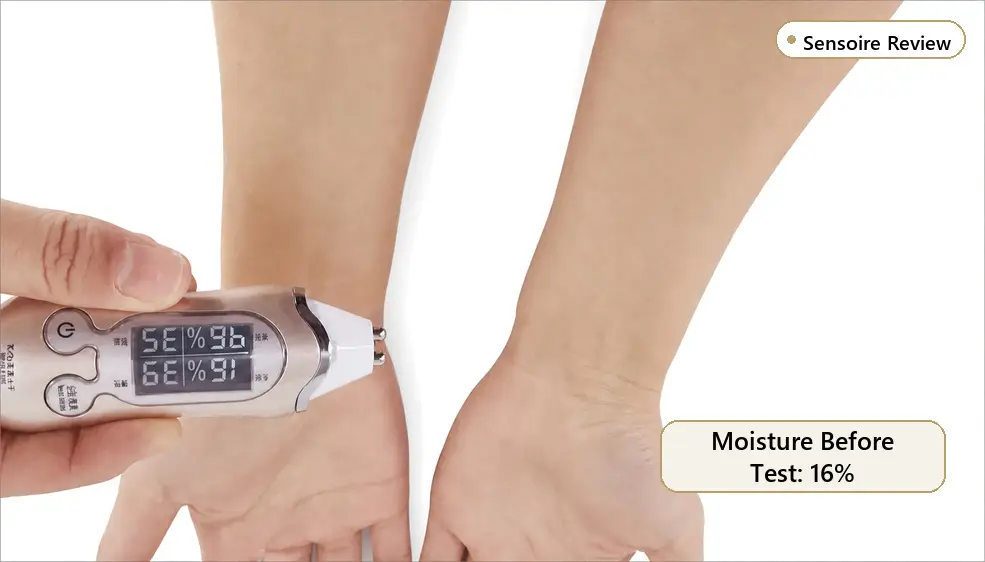
Before the comparison the skin moisture meter read 16%. That number is the baseline for everything that follows.
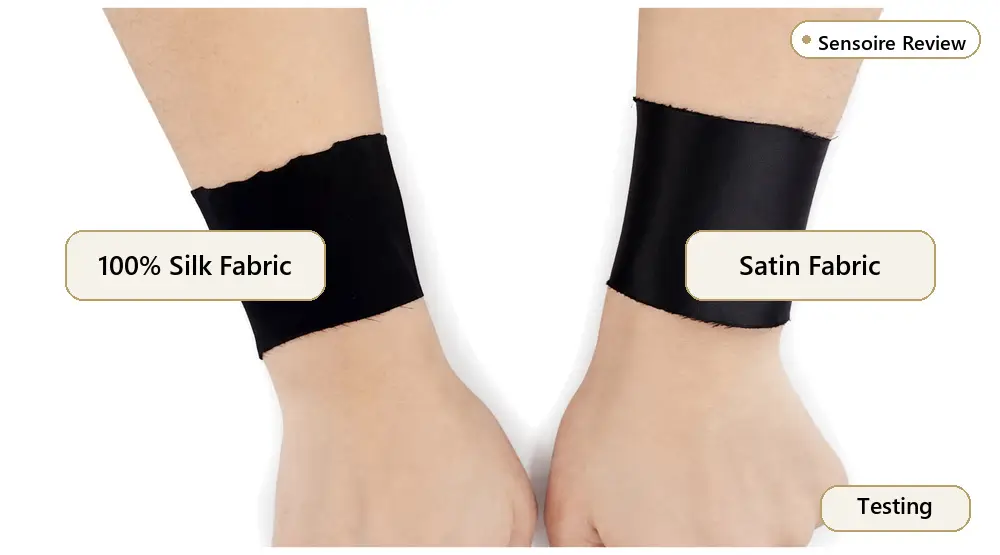
We then wrapped the silk around one wrist and the satin around the other, and left both in place for one hour.
The after photographs show 34% on the silk side and 19% on the satin side.
Those are readings from one person, one meter and one set of conditions. They do not prove that silk moisturises skin. Room conditions, placement, pressure, the person's own skin and the satin sample's exact composition could all move the result.
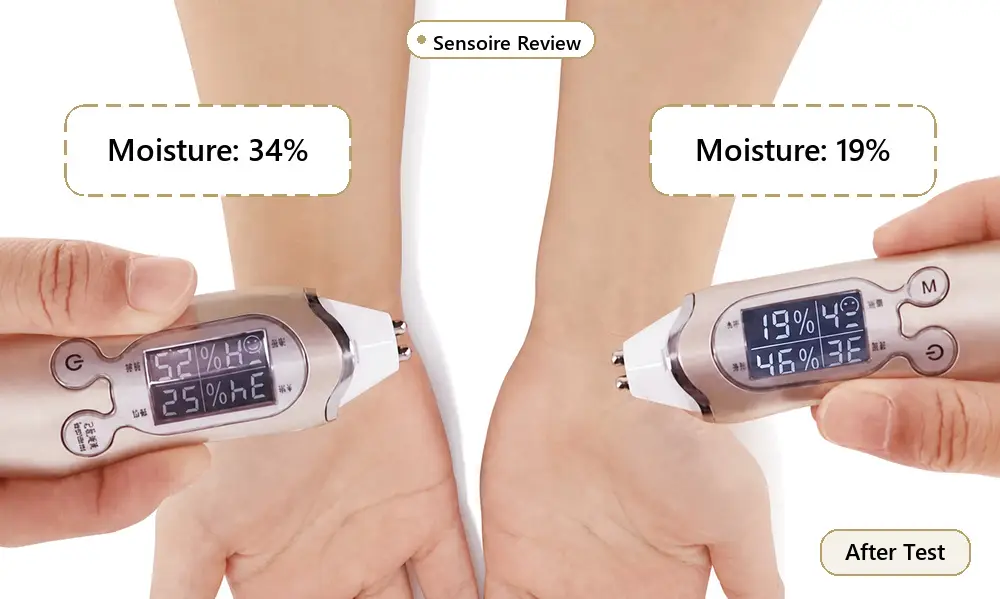
A general cosmetic claim would need a larger controlled study. What the demonstration does show is that the two wrist environments were not identical. Keep the numbers as observations, not as a promise about what every sleeper will feel.
Test 04 · Flame
Test 4: Does the burn test prove silk? Only in a lab
A burn test can point towards silk, but it cannot prove the fibre on its own, and it is not a home method. In our controlled flame comparison the silk sample curled and left a crushable residue associated with protein fibre. The satin sample produced a visible flame, dark smoke and a harder residue. Getty Conservation Institute guidance describes similar flame behaviour for many silk samples, and the industry method for this kind of identification is AATCC TM20, Fiber Analysis: Qualitative, which combines burning, solubility and microscopy rather than relying on a flame alone.
There are too many variables for this to be a sensible home test. Blends, dyes, coatings, flame treatments and weighted silk can all change the flame, the smell and the residue. Formal textile flammability testing uses a controlled chamber, timed equipment and fume extraction, which is very different from holding an unknown fabric over a kitchen flame.
Do not burn a pillowcase, a garment or bedding to identify it. Fire and unknown fumes are a poor trade for information that should already be on the label.
Test 05 · Chlorine
Test 5: The chlorine bleach test is decisive, and destructive
Chlorine bleach is the most decisive of the five tests because it attacks silk protein directly, and it is the only one that destroys the sample. That makes it a laboratory comparison, not a check to run on a pillowcase you intend to keep.
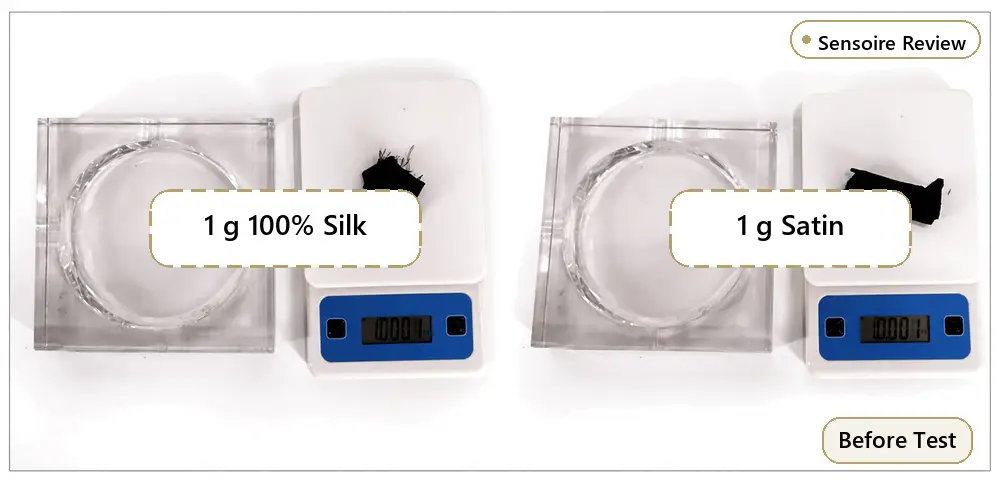
For our chemical comparison each sample weighed one gram before testing. Equal weights, equal time, separate baths.
The samples then went into separate chlorine bleach solutions for 30 minutes, under controlled conditions.
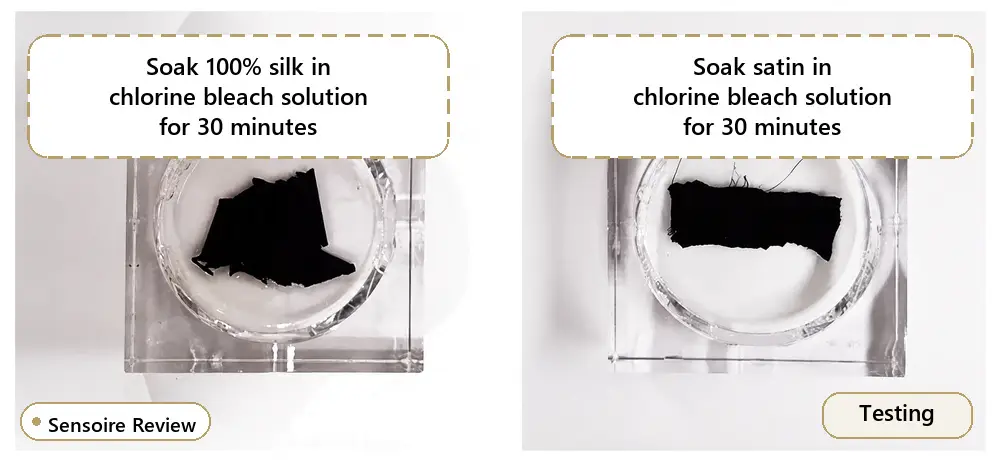
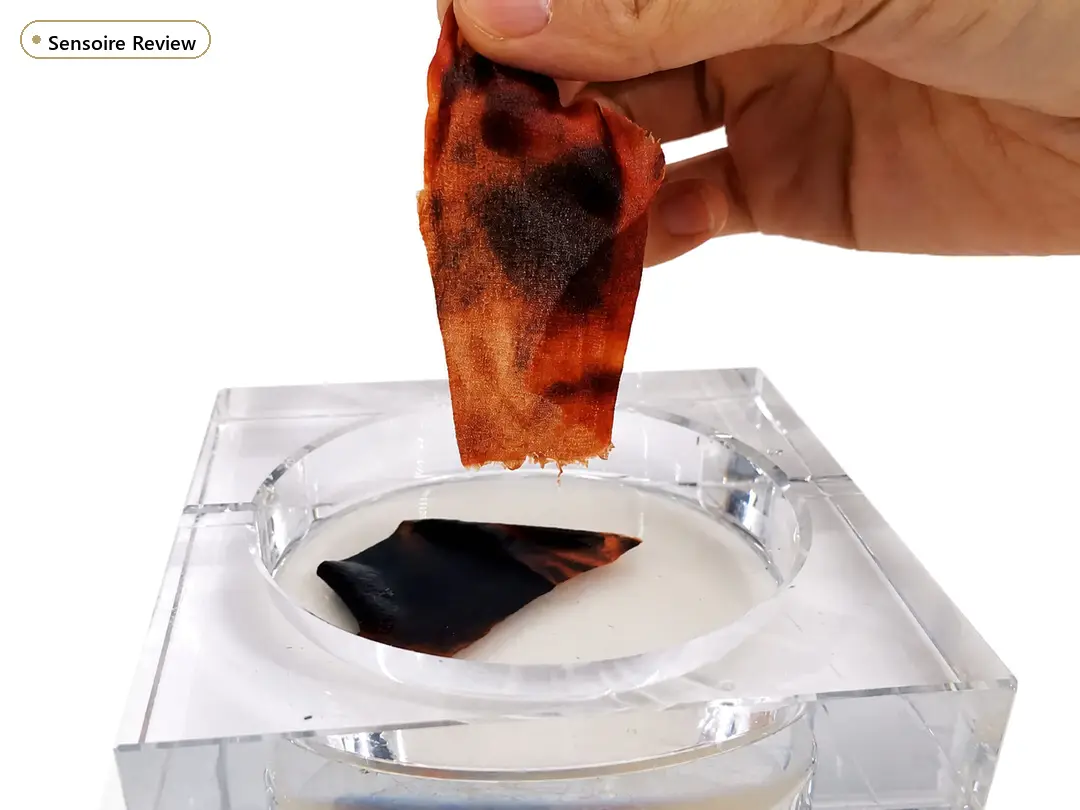
After 30 minutes the silk had lost colour and was breaking down. The satin sample showed no comparable visible change.
Silk is a protein fibre. Conservation laboratory guidance notes that a 5% sodium hypochlorite solution can dissolve silk and other protein materials.
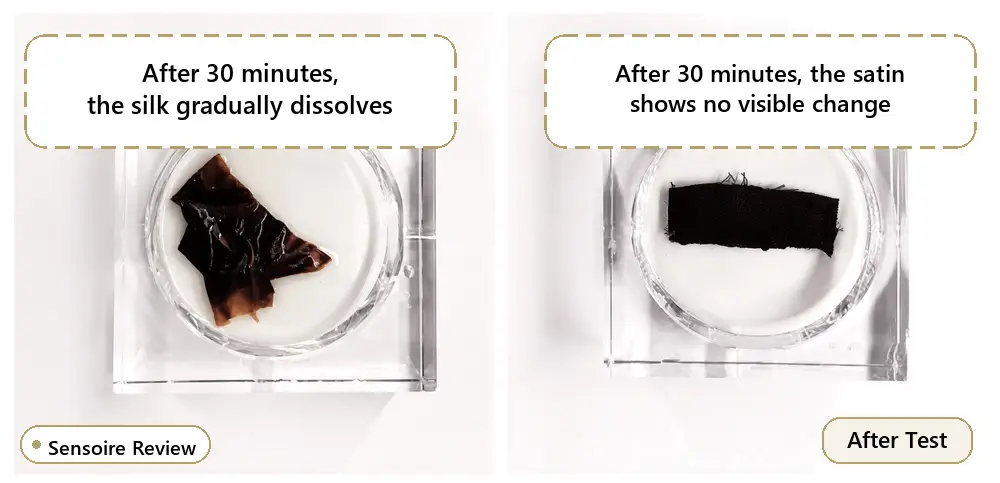
The intact satin sample tells us about that sample's response, not about every fabric sold as satin. A silk satin would still contain silk protein, and blends or finishes may react differently.
This is not a home method. Sodium hypochlorite is corrosive, can injure skin and eyes, and can release toxic gases when mixed with other substances. Stanford's safety guidance calls for ventilation, protective equipment and strict controls. Do not soak a product in bleach to check its fibre.
The safer way: read the label before any test
The safest way to tell if silk is real is the permanent composition label. EU and UK textile rules require the fibre content to be declared, so 100% silk or 100% mulberry silk on the label is a claim you can hold the seller to. Shine, price and the word satin are not.
If the fibre itself is new to you, start with our guide to mulberry silk.
Start with the fibre composition
Look for a specific statement such as 100% silk, 100% polyester or a percentage blend. UK textile guidance generally requires fibre composition to be disclosed and restricts the word pure to a single fibre. US guidance also requires covered consumer textiles to identify fibre content. The Federal Trade Commission labelling guide gives a clear example: a blouse intentionally made with 3% polyester cannot be labelled 100% silk. The label answers the composition question directly, which a shine test never does.
Read fibre and weave as separate information
Silk names the fibre. Satin may name the weave and, in ordinary use, the finished fabric; the full distinction is in silk vs satin: what is the difference. Silk satin gives you both pieces of information. Polyester satin does the same for polyester. A listing that says only satin still needs a composition line.
Use momme after the fibre is clear
Momme describes silk fabric weight. It is useful when comparing two verified silk products, but it cannot tell you whether an unknown glossy fabric is silk. Confirm the fibre first, then ask whether the weight suits a pillowcase, bedding or clothing.
Resolve contradictions before you pay
If the permanent label, the product title and the specification do not agree, ask the seller to confirm the composition in writing. For a high value purchase, a recognised textile laboratory can examine a sample. No improvised household test is worth damaging the item or breathing the fumes.
Does this work for a silk scarf or clothing?
Yes. A scarf, a blouse or a dress is checked in the same order as bedding: the permanent composition label first, then shine, creasing and the one-hour wrist test as supporting signs. Scarves are the harder case, because the label is small, sometimes only a swing tag, and older pieces may have none. Without a label, the three non-destructive tests can only tell you what is likely. Do not burn or bleach a scarf you want to keep, since both tests destroy the fabric they test.
Continue with Sensoire
Silk that passes the label test on line one
Every Sensoire silk product states the fibre, the momme weight and the certification on the product page, which is the only test that matters before you pay.
 Silk pillowcases
100% Pure Mulberry Silk Pillowcase with Envelope Closure
22 momme Grade 6A mulberry silk with a hidden envelope closure, so nothing catches hair in the night.
View product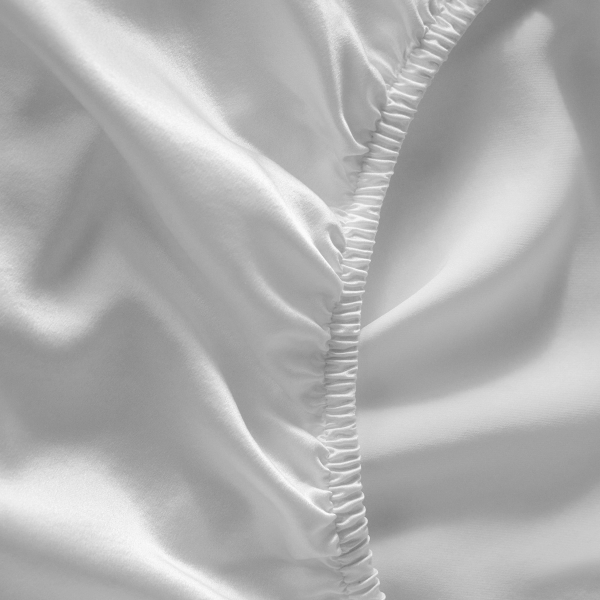 Silk bedding sets
L’Heure de Soie Silk Bedding Set in Blanc Ivoire
22 momme Grade 6A mulberry silk: duvet cover, fitted sheet and flat sheet, each sold on its own, with the weight stated rather than implied.
View product Silk pillowcases
22 Momme Mulberry Silk Pillowcase with Piping
Grade 6A mulberry silk at 22 momme, with the composition and weight stated on the product page.
View product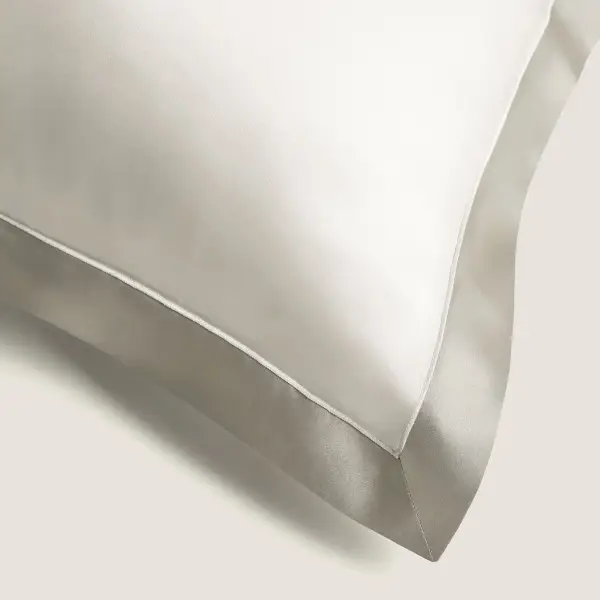 Silk pillowcases
Pure Silk Pillowcase with Oxford Flange
22 momme charmeuse with a tailored Oxford flange and a hidden envelope closure.
View productClear answers, no fibre folklore
Frequently asked questions
01How can I tell if silk is real?+
Read the permanent label: real silk is declared as a fibre percentage such as 100% silk or 100% mulberry silk. Shine, price and the word satin prove nothing. The light, stretch and wrist checks on this page give clues about a specific swatch; only a laboratory method such as AATCC TM20 identifies the fibre with certainty.
02Is 100% silk satin real silk?+
Yes. The percentage names the fibre and satin names the weave, so 100% silk satin is silk woven in a satin structure. Check that the percentage appears on the permanent label, not only in the product title.
03Can you identify real silk by looking at it?+
Not with certainty. Lustre, drape and light transmission offer clues, but colour, weave, weight and finishing affect all of them. Read the fibre label and ask for it in writing if it is missing.
04Does real silk always wrinkle more than satin?+
No universal rule follows from one comparison. Our silk sample showed more pressure marking than the satin sample after one hour, but fibre blends, finishes and weave all change crease recovery.
05Can a burn test prove that fabric is silk?+
A controlled flame test may contribute to professional fibre identification. At home it is unsafe and can mislead when a textile contains blends, dyes, coatings or weighting agents. Do not burn household textiles. Use the composition label or professional testing.
06Should you use bleach to test silk?+
No. Chlorine bleach can break down silk protein, but it is corrosive, destructive and dangerous when mixed with other substances. The photographs here document a controlled comparison, not a home instruction.
07What is the difference between silk and satin?+
Silk is a fibre from the silkworm cocoon. Satin is a weave with long surface floats that give a glossy face and a dull back, and it can be woven from silk, polyester, cotton or viscose. Silk satin is silk in a satin weave; satin alone tells you nothing about the fibre.